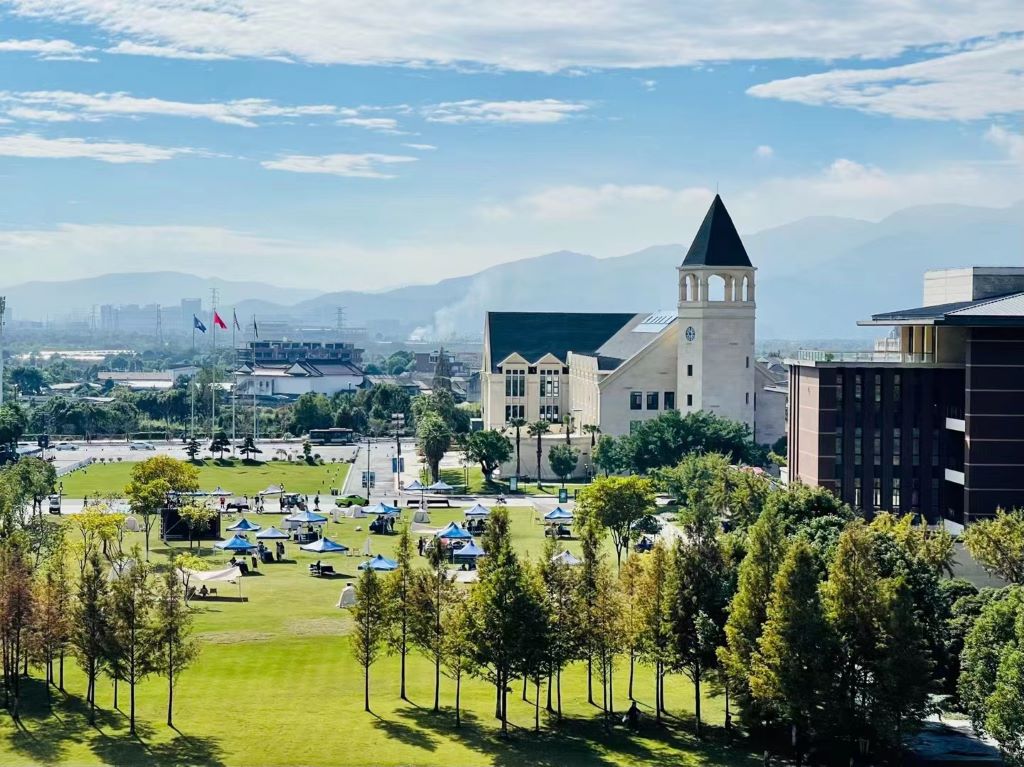
Wenzhou-Kean University (WKU) is committed to building a world-class green, low-carbon, healthy, smart and sustainable campus that aligns with international best practices.
Our Commitment:
Achieve campus carbon neutrality by 2050.
WKU integrates global sustainability frameworks—including the UN SDGs, ISO 14001 Environmental Management System, and leading university sustainability standards—to ensure sustainability is embedded in planning, operations, teaching, research, and engagement.
2. Strategic Goals
Construct an energy-efficient, environmentally friendly, and resource-conserving campus.
Integrate sustainability into academic learning to develop environmentally responsible global citizens.
Engage students, faculty, staff, and the broader community in meaningful sustainability participation.
Strengthen governance, improve administrative mechanisms, and establish long-term sustainability systems.
Promote technological innovation to support continuous green campus development.
3. Core Actions
3.1 Green Operations
Promote green building standards, sponge campus infrastructure, and rainwater utilization.
Improve waste sorting, recycling systems, and waste-to-resource initiatives.
Expand renewable energy use through large-scale photovoltaic installations.
Promote green mobility via shared bicycles and walkable campus planning.
Optimize HVAC systems, lighting controls, and operational energy efficiency.
Implement green procurement principles for environmentally friendly goods and services.
Use the WKU Energy and Carbon Monitoring Platform to achieve precise, real-time management of energy use and carbon emissions.
3.2 Green Education
Offer credit-bearing sustainability courses and organize interdisciplinary sustainability lectures.
Invite experts from diverse fields to guide student sustainability learning and competitions.
Provide sustainability training during freshman orientation and employee onboarding.
Promote sustainability as a shared value and behavioral standard across campus life.
Develop a “Sustainability Learning Pathway” to structure co-curricular sustainability engagement.
3.3 Green Technology
Establish a Green Research Fund to support sustainability-related research and innovation.
Promote industry–university–research collaboration to develop green campus solutions.
Use the campus as a “living laboratory,” piloting new green technologies in real settings.
Explore smart metering, AI-based energy optimization, digital twin technologies, and green materials.
Support student and faculty innovation and entrepreneurship in sustainability.
4. Departmental Plans and Measurable Sustainability Objectives
Departmental Plans that include clear, measurable sustainability objectives across Engagement, Operations, and Administration.
4.1 Engagement Plan: Student, Employee, and Community Participation
Measurable Objectives
Student Engagement
Organize a wide range of sustainability activities to attract student participation.
Engage 75% of the student body by 2026 through lectures, workshops, campaigns, and competitions.
Employee Engagement
Implement a Green Office Certification program covering 50% of administrative units by 2025.
Provide sustainability training for 100% of new employees during onboarding.
Community Engagement
Partner with local organizations to host at least 10 sustainability outreach events annually.
Increase recycling rates in jointly managed community areas by 15% through cooperative initiatives.
These objectives strengthen sustainability culture, improve campus-wide awareness, and expand WKU’s public engagement impact.
Optimize lighting and air-conditioning operations to meet green campus energy standards.
These operational measures support WKU’s carbon-neutral campus goal and align with global low-carbon university standards.
4.3 Administration Plan: Governance, Wellbeing, Resource Management, and Construction
Plan of Governance Structure:
Create a Sustainability Working Group with representatives from academics, administration, logistics, faculty, and students to ensure multi-stakeholder governance.
Further enhance university-wide sustainability policies (energy, water, waste, procurement, mobility, biodiversity) and update them on a scheduled cycle.
4.3.1 Campus Wellbeing and Healthy Campus Plan
Measurable Objectives
Achieve 80% participation in university-organized wellbeing programs by 2026.
Provide annual mental health training for 100% of faculty and staff starting in 2025.
Deliver at least 12 campus-wide health promotion events per year.
Install additional hydration stations to ensure 100% of academic buildings meet water-access standards by 2027.
4.3.2 Sustainable Administration & Resource Efficiency Plan
Measurable Objectives
Reduce total campus electricity consumption by 10% by 2026, without affecting teaching or essential operations.
Implement standardized energy-saving operations (e.g., minimum outdoor lighting, public lighting off after 23:00, AC temperature standards) in 100% of buildings by 2025.
Establish a unified monitoring mechanism for electricity and water, with:
Monthly consumption data recorded for 100% of buildings;
Data anomalies corrected within 5 working days.
Formally approve and implement a University-wide Energy Control Plan by 2025, led by the Logistics Department.
4.3.3 Smart Water and Electricity Meter Management Plan
Measurable Objectives
Achieve 100% smart meter coverage for newly constructed facilities by 2026.
Conduct monthly audits of smart meter data with discrepancies corrected within 3 days.
Require all new buildings to complete:
Pre-acceptance electricity usage meter reading before commissioning;
Quarterly water settlement, coordinated with Logistics.
Remove or deactivate construction-site water meters within 10 working days after contractor departure.
4.3.4 Sustainable Construction & Building Handover Standards
Measurable Objectives
Complete 100% standardized equipment handover (air-conditioning, elevators, water, electricity) with documentation for all new buildings.
Resolve lighting-terminal control defects (e.g., only “all on/off”) within 60 days of system acceptance.
Provide costed proposals for instructional space modifications and implement approved improvements within six months.
Ensure all new buildings meet WKU energy-efficiency design guidelines before final handover.
5. Implementation Safeguards
5.1 Organizational Structure
Establish a university-level Green Campus Leadership Group responsible for top-level planning, coordination, and oversight.
5.2 Mechanism
Promote the adoption of ISO 14001 Environmental Management System, ensuring standardized, institutionalized PDCA closed-loop management.
5.3 Digital Platform
Build the WKU Energy and Carbon Monitoring Platform as the digital “brain” of sustainability governance, enabling emissions to be measurable, controllable, and manageable.
6. Evaluation and Continuous Improvement
WKU will:
Conduct annual reviews of sustainability performance.
Publish periodic sustainability progress updates.
Gather feedback through participatory evaluation involving students, faculty, and staff.
Benchmark against global higher education sustainability standards to ensure continuous improvement.
7. Conclusion
Wenzhou-Kean University will continue advancing toward its vision of becoming a model green campus in China and globally. Through clear planning, measurable objectives, technological innovation, and strong participation from all stakeholders, WKU is committed to building a sustainable, resilient, and future-oriented campus for generations to come.